
Open Source AI Foundations
25+ years Open source expertise
2000 Red Hat Premier & SUSE Diamond Partner since
Aug 2026 EU AI Act deadline, high-risk AI
100% data stays under your control, on-prem or EU cloud
Why Open Source AI Matters
Artificial Intelligence is transforming how organisations innovate but relying on closed, proprietary AI systems often means losing control over your data, your models & your future.
Open Source AI offers a different path: transparent, secure & fully customisable AI infrastructure that you own and operate.
At Kangaroot, we help companies build & run open AI platforms, from Large Language Model (LLM) deployment & inference to OpenShift AI clusters; ensuring full sovereignty over their data & compute.
Open Source AI vs. Closed Cloud AI
| Open Source AI (Kangaroot) | Closed Cloud AI (ChatGPT / Copilot / ...) | |
| Data leaves your network | Never | Possibly; often to servers outside the EU |
| Used for model training | Never | Possibly; depends on provider & subscription |
| Works air-gapped / offline | Yes | No |
| EU AI Act compliance | Easier, under your own governance | Depends on the cloud provider |
| Vendor lock-in | None | High |
| Cost model | Fixed investment, or a managed service | Ongoing per-use subscription |
| Audit trail & logging | Fully under your own control | Depends on provider |
LLM Serving & Inference
Running modern AI models requires more than just computing power; it needs orchestration, optimization, & cost control.
Kangaroot designs and operates LLM serving environments that make inference scalable, efficient & reliable; whether you’re deploying models like Llama 3, Mistral or custom fine-tuned variants.
We implement open source inference frameworks such as vLLM, Text Generation Inference (TGI) & Ray Serve, enabling intelligent autoscaling, GPU scheduling and performance tuning. Our experts integrate these pipelines with your CI/CD & monitoring stack, ensuring predictable latency and optimal resource usage; from proof-of-concept to production.

OpenShift AI
Enterprise AI on Open Source Infrastructure
Built on Red Hat OpenShift, OpenShift AI provides a secure, hybrid platform for managing AI workloads at scale. We deploy OpenShift AI clusters that combine Kubernetes-native MLOps, model training environments & secure GPU orchestration; empowering your data scientists to experiment quickly while your operations teams maintain governance and compliance.
Through integrations with JupyterHub, MLflow, and model registries, we create a seamless environment for model training, versioning & deployment; all powered by open technologies.
How We Work
-
Consulting & architecture
We assess your data and infrastructure landscape to design AI platforms that balance performance, security & sovereignty.
-
Implementation & optimization
Our engineers deploy & tune AI clusters; from LLM inference pipelines to full OpenShift AI environments; ready for enterprise workloads.
-
Training & enablement
We help your teams master open source AI tools, from model hosting to observability & scaling practices.
-
24/7 Managed AI platform support
Our 24/7 support team monitors & maintains your AI infrastructure, ensuring stability, performance and cost-efficient operations.
What this looks like in practice
- Search contracts & documents instantly, with source citations
- Ask questions against your internal knowledge base
- Analyse policy documents & compliance reports
- Explain & review source code
- Structure meeting notes & transcripts automatically
- Compare tender & quotation documents side by side
Frequently Asked Questions
-
What is open source AI infrastructure?
It's the layer beneath AI applications; compute, orchestration & model-serving; built on open technologies you control, instead of a closed platform from a single cloud provider. Kangaroot builds this on OpenShift AI & open LLM frameworks.
-
Can I run AI models on my own hardware instead of the cloud?
Yes, and it doesn't have to be your own hardware either. Kangaroot helps companies move from training models (often done elsewhere) to making them production-ready on their own infrastructure, or on a sovereign EU cloud partner like Exoscale or IONOS, so inference & data stay under your control either way.
-
Do I need proprietary AI platforms to get started?
No. Open source already provides the building blocks; frameworks like TensorFlow & PyTorch, running on OpenShift AI. Kangaroot combines these into a working platform instead of you building it from scratch.
-
Why does AI sovereignty matter?
Handing your data & models to a closed, proprietary AI system means losing visibility into how they're used. An open source AI foundation keeps your models, your data & your compute under your own governance.
-
What does the EU AI Act mean for my AI infrastructure?
From 2 August 2026, high-risk AI use falls under real obligations: logging, human oversight & auditability. An open source foundation you control makes these requirements easier to meet than depending on a closed, third-party AI platform.
-
Can open source AI run fully air-gapped, without internet access?
Yes. For environments where no external connection is acceptable; such as defence, intelligence or highly classified government use, Kangaroot can deploy fully air-gapped, offline AI environments on your own infrastructure. No internet connection required, no external dependency at any point.
AI is not a revolution. It is a stress test.
We call this the AI era. We talk about breakthroughs, disruption & exponential innovation. But what is really happening today is less spectacular and at the same time more fundamental.
AI is not a revolution. AI is a stress test.
A stress test for our architectures. For our data management. For our governance. And above all: for our organisational structures.
Private AI foundations require several technological components.
-
1. Suitable hardware
AI models in production require high compute capacity and memory bandwidth. Standard server hardware often does not provide sufficient performance. GPUs are better suited for this purpose, but they are expensive to purchase.
Therefore, they can also be rented through European data centers such as Exoscale or IONOS, which helps avoid large upfront investments while keeping data within the EU
-
2. Inference infrastructure
To offer an AI model, an API endpoint is needed to receive requests and return responses. The process that performs this transformation is called inference. The software layer that bridges the API, server, and GPU is referred to as an inference server.
There are various solutions available, both for professional production environments (such as vLLM) and for smaller-scale or local use (such as llama.cpp). -
3. Model lifecycle management
In larger environments, it is important to manage models throughout their entire lifecycle: version control, promotion from development to production, and storage. Thanks to OCI standards, models can be stored in container registries as binary artifacts, making it possible to use existing container lifecycle tools for AI models as well.
-
4. Scaling & routing
When a single GPU or endpoint is not sufficient, additional architecture is required. An intelligent API gateway can distribute traffic across multiple servers with GPUs. This is particularly relevant at larger scale, but not a requirement in the initial phase.

The biggest mistake in AI implementations?
Starting too big
We say it time and time again: start with one use case. One that's clear, achievable, and delivers measurable value. Predictive analytics. An internal chatbot. Something concrete.
But technology is only half the story. The other half is people. Involve your team from the start. Make sure they understand the process and feel part of it. Because without buy-in, there's no adoption; no matter how good the technology is.
As a Premier Partner of Red Hat, we make sure that first step is built on solid ground. On an open platform that scales with you, without vendor lock-in. From one use case to organisation-wide rollout; at your own pace.
Related news
-
Enjoy the full power of Open Source! Kangarun operates, updates, monitors and fixes your Open Source platforms & projects so you can focus on what brings value!
-
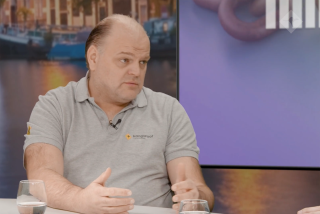
Kangaroot helps organisations build open, sovereign IT ecosystems; full control over data, infrastructure & software, aligned with European values.
-
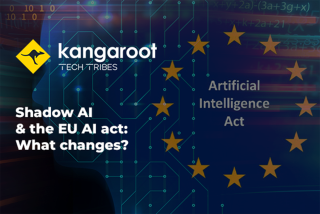
From 2 August 2026, high-risk AI use falls under real obligations. Kangaroot explains what shadow AI costs you & how to take back control.


