Technology is not the problem. Our organisational structures are.

We like to talk about the speed of technological innovation, about AI breakthroughs, scalable cloud platforms and exponential computing power. Yet technology is rarely the limiting factor. The real challenge lies in how organisations deal with it.

Technology moves in waves. Organisations move in projects.
That tension explains why so many digital initiatives struggle. New systems are implemented within old mindsets. Innovation is added, but not integrated. The result is predictable: modern technology constrained by outdated organisational models.
IT does not develop linearly. Each wave shifts the focus. First came automation, then scalability and cloud. Today, the center of gravity is shifting toward control, context, and autonomy.
The rise of generative AI accelerates that shift. AI is not just another tool in the toolbox; it is a technology that fundamentally challenges existing assumptions. It raises questions about data quality, architecture, compliance & accountability; questions that have often lingered beneath the surface for years.
What AI makes visible is that many organisations do not fully control their foundations. Experimentation may succeed. Scaling is a different story.
AI forces maturity
The real value of AI does not lie in quick demos or proof-of-concepts. It lies in robust, production-ready applications that are reliable, explainable and secure. And that is precisely where the importance of underlying structures becomes clear.
Without a clear data architecture, well-managed metadata & strong governance, scalable AI cannot emerge. AI does not operate in a vacuum. It amplifies what is already there, including weaknesses.
That makes AI less of a hype and more of a stress test for organisations.

Context is the new infrastructure
Data alone is not enough. Context is decisive. AI systems must not only process information but understand what it means, where it comes from, and under what conditions it may be used.
That context does not arise automatically from technology. It is created by people, processes & clear agreements. This means collaboration between humans & machines is not an abstract future vision, but a concrete organisational model.
AI does not replace human expertise. It enhances it, provided the right conditions are in place.
Openness is a strategic choice, not an ideology
Open technologies & open models are not an ideological statement, but a strategic decision. Openness creates transparency. It enables adaptability. It prevents organisations from becoming locked into dependencies that limit their agility.
But openness is not a shortcut. It requires maturity, clear accountability & deep expertise. Without these conditions, it merely creates new complexity.
Agility is not speed, but design
Many organisations equate agility with speed. True agility, however, is a matter of design of structures that treat change not as an exception, but as a constant.
This requires a different mindset:
- fewer large-scale,
- one-off transformations,
- and more continuous evolution.
Less focus on tools, more focus on foundations.
The central idea is clear: technological progress creates value only when organisations are willing to reorganise themselves around that technology; not superficially, but structurally.
The next wave is already underway. The question is not whether technology will evolve faster. The question is whether organisations will finally move with it.
Watch full interview
Read more
-

Kangaroot builds open source AI infrastructure: LLM inference, OpenShift AI & GPU orchestration, secure & entirely under your control; on-prem or EU cloud.
-

Kangaroot helps organisations build open, sovereign IT ecosystems; full control over data, infrastructure & software, aligned with European values.
-
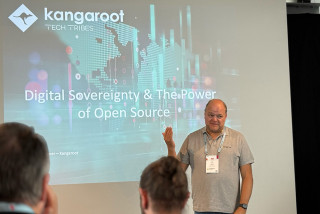
To the Cloud & back again. Is Open Source the key to Digital Sovereignty? Peter Dens at Red Hat Summit Connect Brussels 2025


Related news items